The Mystery of Low Productivity

Standard

It may not be all to do with having too many people making coffee for other people who could boil a kettle and make themselves a cup of caffeine-rich brown liquid in much less time than they have to wait for an expert to do it for them with a hissing big machine and put a beige heart-shape on top.  In the last few days I have had a cluster of revelatory experiences . . .

It’s rare for an email to go astray, and when it does happen one usually gets an ‘undeliverable’ notification. But it’s now common not to get a reply. It’s called “ghosting”. A month ago I sent five emails to businesses that had expressed some interest in sponsoring my Lions Club’s art show last year – but only when the impact of Covid-19 had passed.  Not a single one replied, even to say, “Sorry, times are still bad.” Or “Buzz off or I’ll call the cops.” Nothing. So I’m wasting time following up: “Perhaps my email of 9 June found its way into your Junk folder…”

Twice in the last week I’ve had occasion to contact private companies and been told, “Oh, the person responsible for that is away for a month.” I gently suggested that a) I was talking to that person’s deputy and b) even if so-and-so was physically away they probably still had access to a telephone and an inbox. I refrained from any sarcastic mention of carrier pigeons. “Yes, but I’ll have to wait for so-and-so to come back to give you a definite answer.” People are scared to take responsibility.

I attended a first aid class (CPR and defibrillator operation) run by a very well-known NGO. It ended with a practical test and… Hurrah! All fifteen of us passed! No we jolly well didn’t, not really. We got certificates for showing up and paying a fee. If that applies in other fields… well, perhaps that’s why people are afraid to take responsibility: they know they’re not competent.

My bag was searched at the Aldi check-out. I had some mixed grain wraps in there, just purchased from a rival shop where I had declined a receipt. Fortunately the brand was one that Aldi doesn’t sell or I might have been writing this in a cell. I under­stand: shoplifting is on the rise, forcing businesses to divert resources to strengthening security.

I was just notified that an old class action against a company that had misled its shareholders had been settled, and Mrs SG’s and my pension fund had benefited to the tune of $1,090.60.  How many hours of costly people’s time had been expended on achieving that movement of money from one set of pockets to another set (mainly in the well-cut suits of lawyers)?

This week I spent half-a-day shopping around for cheaper electricity, having been informed in a curt email that my tariff was about to increase from 34.96 to 49.5c/kWh. Disingenuously I phoned to report an apparent misprint, and was told, “No, that’s the rate you’ll be charged if you do nothing, but I can offer you a special rate. And if you can find an even better one with another supplier, come back to us and re-negotiate.” I shopped around, found a better rate and took it. Life’s too short to bugger about endlessly. ’Scuse my French.
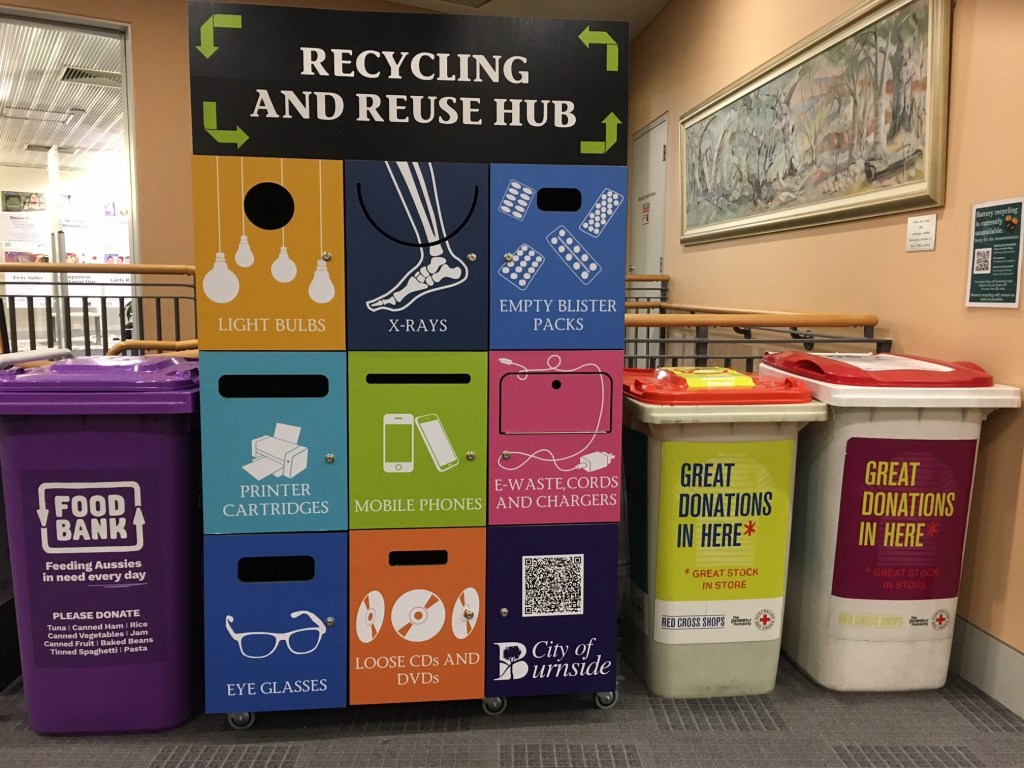
We used to put all our rubbish in the dustbin. Now we have three wheelie-bins: Green for organic waste; Yellow for stuff that can be recycled; and Red for real rubbish destined for landfill. If one is conscientious, getting it right takes time. And the last time I was in our local civic centre I saw this Recycling Hub! Don’t get me wrong, I like it, and I tipped several dozen blister-packs (bonded plastic and metal, hard to separate) into the top right-hand slot. But this means more person-hours spent unproductively – not in producing goods and services that people want.
Home-Grown Fruit and Stroppy 2019

Standard

Nectarines

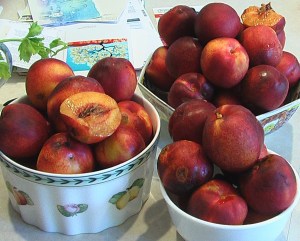
Today’s my birthday and therefore the day to announce the winner of this year’s Stroppy. But first I make will make another announcement: Mrs SG and I have harvested our nectarine crop! It amounted to 7.2kg after cutting off the rotten bits. St Bernard’s Market is selling yellow nectarines A$2.99/kg at the moment, giving our crop a retail value of A$21.50. Mrs SG wondered aloud whether that would cover the cost of watering the tree for a year.

I was reminded of an email circulated recently by my old friend Ron Allan. It was a picture of lots of tomatoes with the caption “Growing your own tomatoes is the best way to devote 3 months of your life to saving $2.17.” Well, Ron, even if that’s US$2.17, we did much better than that!

That curtain-raiser is little more than an excuse to display a colourful picture of our nectarines. Now to the main business. The winner of the 2019 Stroppy Award for Meaningless Drivel is … drumroll … the South Australian Academic Health Science and Translation Centre, for this passage from a report to the state government agency SA Health:

“What we can deduce from our work is that it is possible to generate a narrative around the experience of multiple stakeholders, going through a large-scale system change, in ways that both acknowledge the limitations of the data but support the emerging themes from the data, and from other (realist) literature reviews.”

A worthy winner! Thanks are due to Brad Crouch, the Advertiser’s Medical Reporter, who drew this to my attention.

Cobbling in Jerusalem

Standard

Cobbled in Jerusalem
Your shoes will never wear.
In fact with so much use of them
You’ll have them still whene’er
The time is come to meet your God;
Then at that Pearly Gate
St Pete will say, “You’re so well shod!
“Come in – no need to wait!”

Mrs SG and I are in Jerusalem, and yesterday we went into the walled city to poke around, buy some gifts and find a cobbler: a heel had fallen off one of my shoes and I couldn’t find it. At the Jaffa Gate we were accosted by a personable young guide, whom we didn’t hire but who showed us on a map where we could find a sandler who might perhaps cobble on the side.

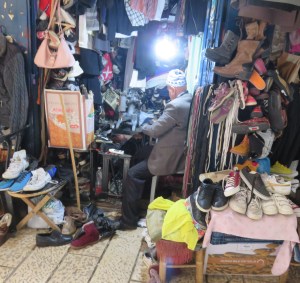
We found the man – an old, old man – in Jewish Quarter Road, occupying an alcove packed with shoes and boots and a heavy-duty sewing machine. I showed my shoe and he said, “Come back in an hour.”

We did and the shoe was heeled. He’d added a bit of rubber to the other one too, to make them almost the same height. The work was functional rather than elegant, and looked robust. “How much?” I said. He indicated that it was up to me. I made the mistake of saying, “No, no, tell me how much I owe you,” to which he replied, “Fifty shekels.” That’s about US$14. My eyebrows lifted, my eyes widened and my blood ran cold, but what could I do?

Therefore I choose to believe that Jerusalem’s spiritual richness will imbue my shoes with supernatural longevity.

Disruptive Technology

Standard

Disruptive technologies are scary.  Uber is one of the scariest, in Australia anyway, because many people have invested 6-figure sums in taxi licences on the assumption that their value can only go up.  Airbnb is another one.  People have invested millions in hotels, meeting all the health, safety, traffic management and other government requirements, only to find that anyone with a spare room is a potential competitor.

My view is simple. In the long run the most efficient way of doing something will always displace the other ways.  Vested interests will howl in pain and rage, and for a while they will hold back the incoming tide.  But eventually, as King Canute found out, they will have to yield.

I remember attending a conference 20+ years ago at which the late James Strong, then CEO of Qantas, argued for a lifting of the ban on Qantas carrying passengers between Australian airports.  The purpose of the ban was to protect the Ansett/TAA duopoly of domestic routes, and it meant that Qantas was flying half-empty ’planes around.  It couldn’t go on forever and it didn’t.  Economic and commercial rationality prevailed – as it must in the taxi and accommodation sectors.

Instead of emulating King Canute, governments should:

  • Create sensible regulatory frameworks for the new technologies, to ensure public safety and payment of taxes.
  • Review the rules and taxes that make it hard for established businesses to compete on equal terms with the disruptors.
  • Ease the pain for the people whose lives and businesses are unexpectedly disrupted, eg by buying back taxi licences.


Power

Standard

Yesterday I rowed 500m – not on an actual lake or river, but on a rowing machine in a gym. I rowed hard and was panting at the end.  My average power output was 152 watts.

Were I able to row like that for 8 hours per day, six days per week, my output would be equivalent to 5% of the electrical energy that Mrs SG and I consume.

If my efforts were rewarded in cash, at a rate corresponding to the average price we pay for electricity, I would be earning about US$2 per week. Maybe electricity is not so absurdly expensive after all.

So why am I stroppy? Because a calculation like that makes me feel feeble and inadequate!

Buying a New Car

Standard

Mrs SG and I just bought a new car – the first new car we’ve ever bought. My first car cost GBP60. My first car with 4 wheels cost GBP220. This new car cost AUD25,500!

At least, that’s what we thought it cost when we’d finished negotiating with the salesman. Then a young lady with a lovely smile and a strange title came to talk to us. She explained that if we wanted the really important ‘extras’ – that we might have supposed were already built into the car, what with it being a new car and everything – we’d have to pay another AUD1,700.

So beware, dear reader! Before your sign anything in a car showroom, ask if that’s the lot. I think we’ll go back to buying second-hand… except that at our age this new car is probably going to last longer than we do.

Duty-Free Liquor Prices

Standard

I’m in Armenia, the land of fine brandy.  At the supermarket today I saw a half-litre bottle of Grant’s whisky for the equivalent of US$9.38.  That’s US$14.07 for a standard 750ml bottle.  The Armenian Government whacks on import duty (10%), excise tax (30%) and VAT (20%) and I suspect that the supermarket still manages to make a profit.  But that fully-taxed retail price beats the typical price in any airport duty-free shop that I know of.

It does not come as a surprise that duty-free shops make mega-super-profits, but can anyone tell me where they go?  Are governments creaming off a tax under another name?  How much goes to the airport owners?  Is the whole duty-free racket a way to give backdoor subsidies to the civil aviation industry?  This would be consistent with the airlines’ exemption from tax on the fuel they burn and the tickets they sell.

Can anyone enlighten me?