Stroppy 2024!

Standard

As we bid farewell to the Emmys the spotlight turns towards the Stroppys – or rather the Stroppy, there being only one such award for meaningless twaddle each year. After much thought and hand-wringing the winner is… drum roll… anonymous. Yes, that’s unfortunate, but I don’t know the name of the author of this gem, extracted from a report written for a certain international financial institution based in Washington DC:

James Joyce (portrait)

“A weigh station that is also a public check post shall undertake checks in its capacity as a weigh station unless it is established to the satisfaction of the authorised officer that the payload on the truck or combination being checked originated from the nearby urban agglomeration in which case the check shall be made in its capacity as public check post, and if the truck or combination is found to have committed an infringement requiring immobilisation then that infringement shall be waived and the truck or combination allowed to travel directly back to its loading point for rectification without penalty or permanent record of noncompliance.”

Marcel Proust (caricature)

At only 106 words this sentence can hardly be considered Joycian or even Proustian. But it makes up for that in its opacity, convolution, clumsiness and… well, let’s just sum it up as twaddledom.

I am indebted, not for the first time, to my long-term friend and sometimes colleague Ron Allan, who nominated this passage.

And here’s an unrelated thought bubble… I just read that the average human exhales 255kg of CO2 per year. That’s equivalent to an old-fashioned ounce per hour, so it seems plausible. 

Boeing 747: First roll-out (30 September 1968)

Back to the individual level, the average person exhales about 20t of CO2 over a lifetime. If this number is correct, our species is directly putting 2 billion tonnes of CO2 into the atmosphere annually.  This is as much as 800 million petrol-powered cars.  Or 90,000 Boeing 747s.

Perhaps a childless person who voluntarily undergoes sterilisation should be issued with carbon credits.  What do you think?

By the way, do you happen to know (or be) a film producer in need of a potential blockbusting script for a TV series? If so, please let me know.

Sex Robots

Standard

I just read an article in the online version of the Sydney Morning Herald, about the development and possible consequences of lifelike intelligent sex robots.

If this prospect interests, excites or appals you, I recommend clicking on this link to read the article and watch the embedded video. I also recommend buying Goldiloxians (The Eeks Trilogy in a single volume) which features sex robots and the practical and ethical complications they may give rise to.

Musings from Bangkok

Standard

That’s not a very informative title, but I’m posting about two separate things and I happen to be in a transit lounge in Bangkok with a lot of time to spare.

I just came off a flight where I watched a film I’d vaguely heard about and a documentary about the Cassini mission to Saturn. Both affected me to the extent that I want to share.

The film was ‘Downsizing’, starring Matt Damon. It has been described as sci-fi satire but I don’t think that does it justice. The title relates to a scientific breakthrough that reduces people to 1/14 their height, and consequently 1/2744 their volume and mass. The aim is to reduce humankind’s environmental footprint before we destroy our habitat, but it has the side effect of allowing the ‘small people’ to use their savings to buy huge mansions in special resort-like communities and live lives of leisure and luxury.

I want you to see the film, so I won’t say any more – except to laud the actress who was for me the de facto star (see photo). Her name is Hong Chau, born in Thailand of Vietnamese refugee parents and now living in the USA. She plays a Vietnamese activist and amputee and she is superb.

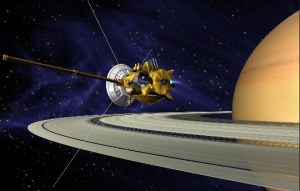
The Cassini documentary starred the gallant little spacecraft itself, which was sacrificed at the end of a spectacularly successful mission. It was vaporised in a fireball in Saturn’s atmosphere, with eerie echoes of ancestral sacrifices to uncaring gods. This sacrifice was necessary to avoid the danger of terrestrial contamination of an environment where life already exists or one day may.

I found myself tearing up, not because of Cassini’s death, but because the whole enterprise showed what our species can do and be at our very very best. NASA had a huge team of specialists, men and women, young and old, from many nationalities. They had a common goal to know, a dedication to science, and no malign intent.

The NASA team’s goodness contrasted starkly with the recent horror in Indonesia where a whole family, young children included, wiped itself out in coordinated murderous attacks. This was a team effort too, but instead of being enthused by science their minds were infected by a perverted ideology that thrives only on ignorance and superstition. This was our species as its very very worst.

When humans are over

Standard

Many marvel at my magnanimity, as well as my alliteration. I set up my blog to promote my own writings, yet from time to time I use it to draw attention to the work of my competitors. Today I’m doing it again.

“When humans are over, and have become just another geological stratum, the entirety of our existence will be represented by a layer no thicker than a cigarette paper. Now I find that rather beautifully humbling.”

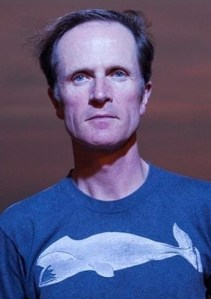
That is the closing passage of an article in the Guardian Weekly by Philip Hoare (pictured) whose works include Leviathan and The Sea Inside.

These words resonated with me so strongly that I clipped them out immediately. It is exactly this sense of the fragility of our species, combined with its uniqueness, that inspired me to write The Eeks Trilogy.

“What ‘uniqueness’?!” you may protest. “We share Earth with millions of other species that feed, grow, reproduce and die just as we do, and throughout the universe there may be billions more!”

“Aah,” I reply, “but we have yet to meet, or find the skinniest of evidence of, another species with anything approaching our capacity for abstract thought, for curiosity, for imagination or for reasoning. How many dolphins have figured out the Laws of Motion? How many daffodils have made it to the moon?”

If we are unique, if ours are the only minds that have even asked the fundamental questions, we really should take better care of ourselves.

They Know Everything About You!

Standard

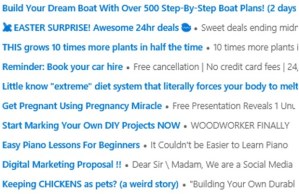
Or do they? Here is a listing of the junk mail I received today, as filtered by Hotmail:

I have never expressed, in thought word or deed, online or offline, the slightest interest in building a boat, gardening, extreme dieting, getting pregnant, learning the piano or keeping chickens (whether for fun, for profit or for deviant sexual purposes).

If that’s an indication of what Big Brother’s algorithms have worked out about my life, I am relieved.

On the other hand, since I am relying on those algorithms to steer people who are interested in robots, artificial intelligence and extraterrestrial colonisation towards my books (The Eeks Trilogy published in a single e-volume ‘Goldiloxians’), I am distressed. Are my potential readers being directed to cricketers’ autobiographies and railway timetables?! Rather more efficient invasion of privacy is called for, I think.

Sapiens

Standard

sapienscover

It shows great generosity of spirit when one author recommends the work of another. This I now do.

I’ve just finished reading ‘Sapiens’ by Yuval Noah Harari, and I urge you to read it too. And give it to your friends and relatives, or at least recommend it to them. It’s subtitled ‘A Brief History of Humankind’, and although there may not be much there that you don’t already know, he puts it together in a way that makes one think about it differently. At least, that’s how I felt.

Best of all, Dr Harari ends by speculating about what will happen next in Homo sapiens’ journey, when our powers to create and control will truly make us godlike and the next step in our evolution will be of our own making.

It put me in mind of my own modest work: The Eeks Trilogy, available from all good e-book retailers in a single volume entitled ‘Goldiloxians’, which speculates about our future dealings with intelligent robots. But do read ‘Sapiens’ too.

Intelligent Design

Standard

I am a writer of science fiction – or social science fiction, as I have redefined my chosen genre in an as-yet unsuccessful attempt to create a new market in which I am the sole supplier. Apart from pitifully low sales figures, my main concern is that science fact will overtake me, leaving my speculative, imaginative, provocative stories looking like ho-hum period pieces.

This concern of mine was reinforced today by two stories at the BBC’s admirable website. One is about a self-contained robotic octopus made of jelly-like materials, intended as a prototype of something that will one day perform autonomously and slither into spaces that robots with rigid components cannot. It’s a good read.

RoboticOctopus

The other story is about the future evolution of our species. The idea is that we have evolved as far as we can by means of natural selection, which is in any case too slow for our immediate needs. We now have to design and make our own evolutionary adaptations, which will almost certainly entail combining organic and inorganic elements. This story is very short and told audio-visually.

SHAMELESS PLUG

If those stories pique your interest in what I’ve been writing, and if you’re willing to buy and read e-books, you can get my trilogy of books in an omnibus edition called ‘Goldiloxians’ at all the major e-book retail platforms. Here are two links:

Goldiloxians’ at Amazon/Kindle

Goldiloxians’ at Smashwords

Goldiloxians

Standard

There is a buzz of excitement in the literary world today. For the first time ever, all three books of The Eeks Trilogy are available in a single e-volume. Entitled ‘Goldiloxians’ it is for sale at Amazon/Kindle, Smashwords, Apple, Kobo and other e-book retail platforms at the absurdly low price of US$4.99.

Goldiloxians-72dpi-1500x2000 (2)

Why such excitement? The Eeks Trilogy is thought by some to be the first example of an explosive new literary genre, which concentrates on human responses to change brought on by scientific and technological advances and speculates on the future path that our species will choose. This new genre has been called Social Science Fiction.

Don’t be unprepared when the conversation at your next dinner party turns to Social Sci-Fi. Be the first to say, “I suppose you’ve all read ‘Goldiloxians’?”

Baltic Sea Anomaly

Standard

I’ve seen some bizarre things, but this picture (from www.martianherald.com) looks too bizarre to be natural. It screams, “Flying saucer!”

BalticSeaAnomaly2

Just left of centre you can see two scuba divers, the front one carrying a light.  The following text accompanies the picture:

“Swedish divers came across a circular rock-like formation on the Baltic floor measuring 60 meters in diameter, 3 to 4 meters thick and standing on an 8-meter tall pillar. Both divers and archaeologists are puzzled and don’t know what to make of the object now called the Baltic Sea Anomaly. Researchers have speculated it could be anything from a World War II German anti-submarine device to a UFO, but no definitive conclusion has come forth. The same Swedish diving team that discovered the object later reported that the object was at the end of a 300-meter “runway” and that they had also found what looked like a staircase and a hole leading to the interior of the object. They also claimed that electrical equipment suddenly stopped working in the proximities of the object, which has fuelled speculation that the object is, in fact, an alien spacecraft.”

According to Wikpedia it was found by the Swedish ‘Ocean X Team’ on 19 June 2011.  Do you know anything about it?

As a science fiction writer, I hope it’s not an alien spacecraft. Things like that should remain mysterious and speculative – good for sales.

Self-Publishing

Standard

My sci-fi trilogy is now for sale at Amazon/Kindle.  That was possible only now because Amazon does not sell books at a price of zero, so I couldn’t upload it to them while the 1st book (‘Eeks’) was free.

I’ve changed the covers too. Now they’re more like standard sci-fi book covers, in accordance with the advice from Smashwords: “Your cover is a promise to the reader.”  There’s a language of book covers that we all subconsciously know.  An unknown author struggling to be seen cannot afford to be too original.

You can see the new covers on the ‘Books – The Eeks Trilogy’ page of this blog.

Writing the books was taxing but fun. Following the white rabbit (symbolising Fame and Fortune?) into the world of self-e-publishing has been a bizarre experience.  To get through the door Alice had to drink the potion that made her smaller.  So did I.  I drank the potion and found myself in a world teeming with best-sellers, block-busters and authors that people had heard of.  I was and remain a pygmy.  My poor little books jostle with 24 million others at Amazon alone, each one jumping up and down, waving it’s virtual hands in the air and shouting, “Me! Me! Click on me!”

Then I discovered that writing the books and publishing the books were the easy bits. Publicising the books – that’s the hard bit.  Watch this space for updates about my experiences down the rabbit hole.