Letters to the Editor

Standard

Fame as an author is coming more slowly than I expected, so yesterday I decided to take a short-cut: I wrote a letter to the Adelaide Advertiser.  And it was published this morning!

It wasn’t anything momentous. I was just expressing agreement with an article by Tory Shepherd in the same paper, reinforcing the point that race, culture and religion are distinct things.  I suggested that the three are often mischievously conflated so as to pin the label ‘Racist’ on people who object to some religious beliefs or cultural practices.

But that’s not what this post is about. It’s about the reasons why people write to newspapers – why I write to newspapers.  I’m honestly not sure whether I do it because a) I sincerely believe that my small voice, added to a swell of others, may lead to some incalculable but significant improvement in the condition of humanity; or b) I’m an egotistical attention-seeker frustrated by my own impotence.

Do you write to newspapers? If so, why?
The Bomb

Standard

Remember when we were all afraid of being annihilated in a nuclear war between the USA and the USSR (aka ‘the Russians’)? At least, that’s what historians tell us; I don’t remember being afraid of that personally.

Well now there are so many people with their fingers on so many buttons that nuclear annihilation is just part of the scenery. If Israel, Pakistan and North Korea have nuclear bombs – whether of the atomic or the hydrogen variety – it’s a matter of when and how big, not if.  It’s like the next mega-volcanic eruption or the next really big asteroid strike or the next Global Financial Crisis.  Why waste emotional energy worrying about it?

This post was inspired by Kim Jong Un’s latest test, of course.  Nuclear bomb test, I mean, not psychiatric.  And also by a cool animation I saw in the Washington Post showing the size, location and perpetrator of every test since 1946.  Do have a look.

Self-Publishing

Standard

My sci-fi trilogy is now for sale at Amazon/Kindle.  That was possible only now because Amazon does not sell books at a price of zero, so I couldn’t upload it to them while the 1st book (‘Eeks’) was free.

I’ve changed the covers too. Now they’re more like standard sci-fi book covers, in accordance with the advice from Smashwords: “Your cover is a promise to the reader.”  There’s a language of book covers that we all subconsciously know.  An unknown author struggling to be seen cannot afford to be too original.

You can see the new covers on the ‘Books – The Eeks Trilogy’ page of this blog.

Writing the books was taxing but fun. Following the white rabbit (symbolising Fame and Fortune?) into the world of self-e-publishing has been a bizarre experience.  To get through the door Alice had to drink the potion that made her smaller.  So did I.  I drank the potion and found myself in a world teeming with best-sellers, block-busters and authors that people had heard of.  I was and remain a pygmy.  My poor little books jostle with 24 million others at Amazon alone, each one jumping up and down, waving it’s virtual hands in the air and shouting, “Me! Me! Click on me!”

Then I discovered that writing the books and publishing the books were the easy bits. Publicising the books – that’s the hard bit.  Watch this space for updates about my experiences down the rabbit hole.

Good Advice for Good Health

Standard

My friend Ron Allan forwards a lot of interesting material to me, and I acknowledge him as the source of the following two slivers of good advice:
     Dietary:  “Eat what grandma used to eat.”
     Life style: “Exertion and exercise, like grandpa used to do.”

That’s not an either/or thing, by the way.  If you eat dripping sandwiches and treacle pudding, as many grandmas did not so long ago, you need to do 10 hours of hard physical labour six days a week.

Vacancies at the Midland Bank

Standard

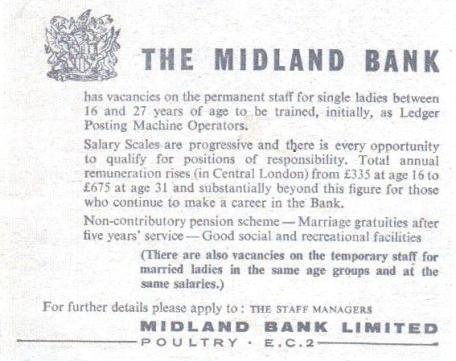
The other day I came across this advertisement in a British newspaper, dated 1960.

Scan_MidlandBankAd_1960 001

I think it’s an interesting capsule of social history. Single ladies could apply for permanent employment, with pension rights and the promise of a gratuity on marriage.  Married ladies were restricted to temporary employment, but at the same rates of pay.

You may, like me, be intrigued by the bank’s address. Poultry is still a road in the commercial heart of London.  It runs for 100 metres between Cheapside and Cornhill, immediately to the south-west of the Bank of England and close to Grocers’ Hall Court, Old Jewry and Ironmonger Lane.  It was where chickens were sold 500 years ago.

I love places that retain their history in their names – and in their monuments (see my earlier post ‘Cecil Rhodes and Other Reminders’). There was a call to change the name of Liverpool’s Penny Lane, made famous by The Beatles, because it was named after the slave-trader James Penny.  I’m glad to say that the good Councillors decided against a change.

Jimmy Carter and the Southern Baptists

Standard

Jimmy Carter and the Southern Baptists

I have always respected Jimmy Carter, even when his enemies portrayed him as a naive do-gooder and drew attention to his being a peanut farmer, implying that such an occupation was incompatible with his role as Commander-in-Chief.

My respect for him went up several notches today when I read that he had severed his ties with the Southern Baptist Convention because of its insistence on women’s subordinate place in God’s creation.  Here is a direct quotation from Jimmy Carter’s public statement on the matter:

“ I have been a practising Christian all my life and a deacon and Bible teacher for many years. My faith is a source of strength and comfort to me, as religious beliefs are to hundreds of millions of people around the world. So my decision to sever my ties with the Southern Baptist Convention, after six decades, was painful and difficult. It was, however, an unavoidable decision when the convention’s leaders, quoting a few carefully selected Bible verses and claiming that Eve was created second to Adam and was responsible for original sin, ordained that women must be “subservient” to their husbands and prohibited from serving as deacons, pastors or chaplains in the military service. ”

Go here to see his statement in full in the Sydney Morning Herald.


Cecil Rhodes and Other Reminders

Standard

A statue of Cecil Rhodes, the British imperialist who did much to promote British imperial interests in Africa, was removed from the University of Cape Town earlier this year.  Now there are calls to have another removed from Oriel College, Oxford.

I have worked extensively in the former Soviet Union where I have seen statues of Vladimir Ilich Lenin, Felix Edmundovich Dzerzhinsky and Joseph Stalin.  Some have been defaced, some have been carried off and dumped – I saw one massive stone head in a railway yard.  But I cannot believe that airbrushing history in this way is ever right.  Surely it is better to confront our past, the ugly bits as well as the glorious, the better to control our future?

In Gori, Stalin’s birthplace, the museum commemorating that bloody dictator has been preserved exactly as it was in Soviet times.  An extra room has been added to supplement its content with a more modern, less laudatory version of events.  Destroying the evidence of history only opens the door to myth-makers.

I don’t always agree with Tony Abbott (former Australian Prime Minister) but I do agree with his stand on this issue.  I believe it is fairly reported in this article from the Sydney Morning Herald.

Golfing in the War

Standard

Someone sent me this temporary set of rules of the Richmond Golf Club, dated 1940.  They illustrate perfectly the kind of stoicism that people are capable of in the hardest of times – and that will be required of us all now and in the coming years as we confront an evil enemy.

GolfRules_Richmond1940

Christmas Wrapping

Standard

We all remember fondly the rituals of Christmas in our youth. I remember one such ritual with especial fondness.  High in a cupboard in the entrance hall was a wide, flat cardboard box in which a suit had been delivered to my father.  The tailor’s name – Hector Powe, – was on the box’s lid.  Inside was the household collection of Christmas wrapping paper.

I had my favourite sheets, as I suppose did the other members of the family. They were like old friends and I took great care not to damage them with sticky tape or excessive creasing.  They were never cut, of course, so the sizes of gifts and wrappings had to be carefully matched.  I don’t remember new wrapping paper ever being bought.

The tailor’s box and its contents have gone – a casualty of my mother’s downsizing to a flat. But in the bottom drawer of a filing cabinet I keep a smaller box with a wide enough assortment of wrappings for my present needs.  Every year some sheets are lost from the collection, to be replaced by new ones from which I have meticulously peeled as such of the sticky tape as I can.  Small blemishes are covered up by ‘From/To’ cards, stick-on reindeer and the like.

My Christmasses would not be quite the same without this.