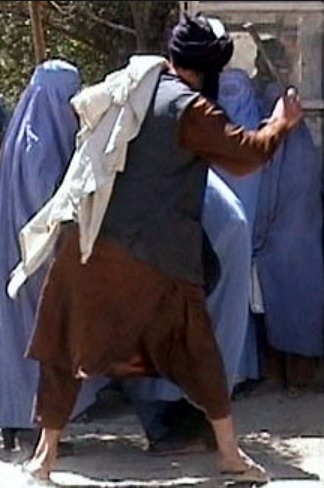
Taliban

Standard

Almost everyone in the democratic world feels the same way about what’s happening in Afghanistan. We went in uninvited, ousted a government and installed a new one, introduced a democratic constitution and oversaw elections. We poured billions of dollars into modernising the country’s infrastructure and institutions. Above all we set new standards for human rights and, in particular, the rights of women and girls. Afghanistan was set for a brighter future under the protection of the mightiest military alliance the world has ever seen – or so it seemed.

And then we said, “Nah. Sod this for a game of soldiers. We’re off.” Or, rather, that was said on our behalf by the US President. None of the allies was strong enough to stand alone, or even in concert if the mightiest of them left the field.

I do not need to dwell on the crimes that the Taliban has been guilty of. In our value system murder, genocide, kidnapping, rape, torture and slavery are heinous. For the Taliban they are standard operating procedure. Even after twenty years, their ideology and the wickedness that flows from it have not changed.

An uncomfortable thought crossed my mind this morning. What if Australia were invaded by the Taliban and we were subjected to the kind of brutal injustice that Afghans now face? How profound would be that shock? How devastated would be our way of life, our self-regard, our sense of place and purpose?

My next thought was even more uncomfortable. Would that devastation be anything like the impact that British colonisation had upon the Aboriginal inhabitants of this land? Were we (I mean my European forebears) the Taliban?


A Farce or a Tragedy

Standard

This is a follow-up to my last post, about selective schools and the need for an elite trained for leadership. I just read an article on populism by Yascha Mounk (Harvard lecturer on government) in the Guardian Weekly, and my attention was seized by the following passage:

What, George Washington asked in his Eighth Annual Address, could be more important than to pass civic values down to “the future guardians of the liberties of the country?”

“A people who mean to be their own Governors,” James Madison echoed a few years later, “must arm themselves with the power that knowledge gives.” His fears about what would happen to America if it neglected this crucial task sound oddly apposite today: “A popular Government, without popular information, or the means of acquiring it, is but a Prologue to a Farce or a Tragedy; or, perhaps, both.”

Of course, it would be ideal to have the entire population ‘armed with the power that knowledge gives,’ not just a meritocratic class That lofty goal has eluded us so far, in America and elsewhere.

Yascha Mounk

George Washington

James Madison


Judo and the KGB

Standard

When President Putin is mentioned in the Western press the phrase ‘former KGB officer’ is often thrown in, presumably to remind readers that this man is smart, wily and not to be trusted. Such a reminder is probably unnecessary. It might be more useful to insert the reminder that he’s a black belt in judo. I Googled ‘principles of judo strategy’ and came up with the following:

Principle #3 Exploit leverage that uses the weight and strategy of opponents against them. Movement and flexibility are prerequisites for judo strategy. They’re crucial to keeping the competition off balance, and they prevent large competitors from dominating smaller, more vulnerable opponents.

This is the principle at the core of President Putin’s success. He looks at the Western allies, which are collectively many times more powerful than the Russian Federation, both economically and militarily. But he sees their weaknesses and understands how to exploit them to his own advantage.

Chief among these weaknesses are democracy, respect for the rule of law, short-termism and a love of comfort. We will make any compromise, betray any promise and scuff out any ‘line in the sand’ to avoid unfavourable poll numbers, shortages, unemployment, encroachment on citizens’ freedoms, accusations of political incorrectness, or armed conflict that might result in a lot of body bags – body bags containing the bodies of our own people, that is.

One could add another to that list: rejection of the nation state as a political ideal. But that’s a big topic that calls for a separate post.

Disclosure: I am working in Ukraine at the moment, and I have every sympathy for Ukraine’s position over Crimea and its eastern parts that are effectively occupied by the Russian Federation. So Vladimir Vladimirovich Putin is not my friend.

Politicians

Standard

Motherhood used to be the hardest job in the world. Now it’s being a politician in a modern democracy. Their power has waned as that of corporations and lobbyists and special interest groups has waxed, but they are still blamed for everything and subjected to merciless ridicule. Worse, they are accused of dishonesty, usually not with malice but which a casual assumption that the words ‘politician’ and ‘liar’ are pretty much interchangeable.

This is both unfair and dangerous. It’s unfair because the job of a politician is to find ways to make everyone feel that their opinions have been respected and their interests served. This is impossible without saying things that are, at the very least, misleading.

And it’s dangerous because if someone is accused of an offence often enough they will start to think, “Well, if everyone thinks I’m guilty of this terrible thing I might as well be guilty of it!” Let’s call this the Suspected Spouse Syndrome. Are we training our politicians to behave dishonestly, just by letting them know that we expect it?

Terrorism in Sydney

Standard

15 December 2014

The big news in Australia today is the taking of hostages in a Sydney café, apparently by Islamists.  We are all shocked of course, but no-one should be surprised.  We are at war.  We send ’planes to bomb IS positions in Iraq.  We should expect them to do all they can to frighten us and harm us.  We are their enemies.

They despise our democracy – in their eyes a weak man-made system that must ultimately crumble before their own, which is simply to follow the will of God.  They hope that our democracy will deliver our surrender.  After all, we are soft and godless and have no stomach for the fight.  We will tell our leaders, “Don’t get involved, don’t spend our money, leave us alone to shop and drink coffee.  Yes, yes, they are evil, but they are someone else’s problem.”

I don’t have a copy of the book ‘Tales of the South Pacific’ to hand, but there’s a passage towards the end in which James Michener extols the strength and courage of free people who choose to resist tyranny.  I’m paraphrasing b ut that’s the gist.  I hope the same might be said of us when the history of our own present struggle is written.