Australian of the Year . . . ?

Standard

It’s a dilemma, I know. We are at war, de jure or de facto, with Daesh and sundry other Islamist organisations in the Middle East and Africa. (For the purposes of this article ‘we’ applies to the people of Australia, but it could apply to the citizens of any militarily active Western democracy.) We are also allied with the USA, other nations and other organisations whose interests align with our own.

So what should be our attitude if a citizen, a civilian, decides to go overseas to fight with one of those organisations? It’s illegal to fight overseas except as a member of the Australian armed forces, and I can see why such a law should exist. How can one be sure that the person concerned has not in fact been fighting on behalf of our enemies – either directly or as a spy or saboteur operating within an allied organisation? What moral responsibility would we be forced to accept it the person were killed or injured or captured or accused of a war crime?

Let’s consider the actual case of Ashley Dyball (pictured below), a Queenslander who has returned from Syria where he fought bravely and effectively alongside Kurdish forces against Daesh.
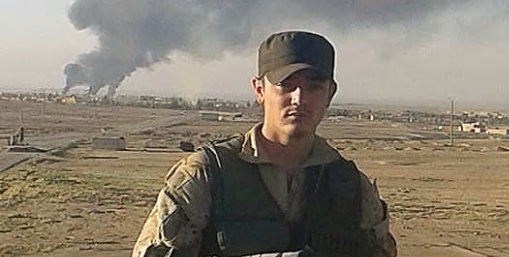
ashleydyball

On his return he was questioned by police and still lives under the threat of arrest, prosecution and imprisonment. But to most Australians he’s a hero, on a par with foreigners who went to Spain to oppose Franco in the 1930s. I would even suggest that he should be nominated for Australian of the Year.

There are thousands of people of warrior age who while away their time playing shoot-em-up video games, or who flee the fighting for lack of means to defend their communities. We should be encouraging those people to take up real arms and kill real enemies – enemies who are the closest thing to embodied evil that we are likely to see in our lifetimes.

Level 2 !!!

Standard

At last, I have scrambled up from the Level 1 floor of the TripAdvisor hierarchy. My review today gave me the 100 points I needed to reach Level 2.  I suppose I’ll get a more exciting badge than the pencil tip logo that I’ve been virtually wearing on my virtual label.

In case you’re interested, I reviewed Tatev Monastery (photo below) and the 5+km cableway that takes visitors across a gorge to reach it. It’s in southern Armenia, not far from the border with the disputed territory of Ngorno Karabakh.  I made my 2nd visit last week.  This time I went back by car to the other end of the cableway (the Wings of Tatev) which allowed me to look at the Devil’s Bridge on the way: a natural tunnel, worn by running water.

Tartev

What I’d really like to do is walk through the man-made tunnel that runs between the monastery, on top of the hill, and the hermitage in the valley. Monks dug the tunnel as a means of escape in the event of an attack.  In the photo you’ll see that the monastery is as much a castle as a place of religious retreat.  Armenians live in a neighbourhood that has seldom been at peace.

As I tried to imagine the physical and logistical obstacles to building a castle-cum-monastery on top of a mountain, and digging a very long tunnel through solid rock, a thought occurred to me. If those Daesh people are as motivated in their religious zeal as those monks of old were motivated, we’re going to have to pull out all the stops to beat them.  Bigger and better Eurovision Song Contests will not be enough.

Orphans in Raqqa

Standard

An Australian woman has died in Raqqa, in DAESH-held Syrian territory, after having surgery for appendicitis.  She left her five young children orphaned, the eldest being a 14-year-old girl.  Their father, Khaled Sharrouf, died earlier, but not before he was photographed making his son hold aloft the severed head of a murdered Syrian soldier.

Some people are now calling on the Australian Government to try to bring the children home. Their plight is horrible, but how could they possible be rescued?  Surely DAESH will not give them up.  They will be indoctrinated, if this has not occurred already, and used as cannon-fodder.  Sending in a special forces team to find them and bring them out would be unjustifiably risky.  Ransoming them would a) put money in the hands of the wickedest people on the planet; and b) encourage future kidnappings and efforts to entice gullible people into DAESH’s clutches, to be traded with their distraught family members or governments.

This case is a tragic one, we cannot always save children from the folly or criminality of their parents. Many thousands of children’s lives are being ruined by parents who use illicit drugs, drink to excess, fail to send their children to school, feed them junk food, and subject them to sexual abuse or violence.

Parent Tumor

Standard

I don’t know if Barak Obama came up with that label for DAESH himself, or if a PR consultant pulled a focus group together and workshopped it.  But it’s a good one.  Militant islamism is a cancerous growth in the body of humanity.  That tells us what kind of treatment it calls for.

Golfing in the War

Standard

Someone sent me this temporary set of rules of the Richmond Golf Club, dated 1940.  They illustrate perfectly the kind of stoicism that people are capable of in the hardest of times – and that will be required of us all now and in the coming years as we confront an evil enemy.

GolfRules_Richmond1940

Islamic Reformation?

Standard

I’ve read and heard several commentators lately, either advocating an islamic version of the Christian Reformation or arguing that such an event has already happened and the results are not pretty.

Former Australian PM Tony Abbott leads the advocacy pack, implying that a reformation would be a modernising influence, moving Islam away from the beliefs and practices that make it barbaric in many people’s eyes.  I don’t want to put words into Mr Abbott’s mouth, but I assume he would share my hope that modernisation would do away with animal sacrifice, pointless dietary rules, punitive mutilation, oppression of women, suppression of other beliefs, contempt for infidels, and capital punishment of individuals categorised as blasphemers, apostates and heretics.

Waleed Aly, a young Australian Muslim who has become my second favourite radio journalist, argues that “Islam’s own version of the Reformation already occurred in the 18th century” and led to Wahhabism, a form of Sunni Islam which is enforced in Saudi Arabia and is the philosophical platform for al-Qaeda, DAESH and other extremist organisations.

Paul Monk disagrees with Waleed Aly in many things but agrees with him in this.  I commend his article in the Sydney Morning Herald.

The UK’s Chief Rabbi, Lord Jonathan Sacks, also agrees. In a recent interview on Australian radio he pointed out that the Christian Reformation was a reaction against corruption in the Catholic Church.  The reformers wanted to return to true Christian values.  This is how Md ibn Abd al-Wahhab saw his 18th century reformation: a return to true Islamic values.

It is as erroneous as it is understandable that we tend to equate ‘reform’ with ‘improvement’, ‘progress’ and ‘becoming more like us’.


Carols

Standard

During the past week Mrs SG and I have attended two carol-singing events organised by local councils. People of all ages brought folding chairs and picnics and sang along with some very talented choirs and bands.  Santa Claus found time to drop in on both occasions.

I am an atheist, but brought up in a Christian cultural environment. I don’t believe that Jesus was the Son of God, any more than I believe in the existence of God, but I was moved nonetheless by The Christmas Story and even felt my eyes moisten during Good King Wenceslas.

The same moistening happened when I read the last chapter of Watership Down, when the Black Rabbit of Inlé came for Hazel.  I was on a Liverpool-bound train to visit my mother for the first time since my father died.  And I was shedding tears for a dead fictional rabbit.

It also happened every time I read the last chapter of The House at Pooh Corner to our elder son – the chapter where Christopher Robin tries to explain to Pooh that he’s going off to school and things won’t be the same.  It’s the end of childhood, the end of innocence.

So I sort of understand people who have been brought up in other religious and literary traditions for whom the stories they heard when they were very young resonate deep within throughout their lives. Sometimes that resonance cause them to do irrational and even – in my eyes – wicked things.


Bombing DAESH

Standard

The news has just come through – the UK Parliament has voted in favour of bombing DAESH in Syria as well as Iraq.  This is a victory for common sense as well as a boost for British self-respect.  The civilised world is confronting the closest thing to pure evil that we are likely to see in my lifetime.  For a nation with such a proud military history – not always a glorious one in moral terms, I concede – to stand back while others are stepping forward would have been a disgrace.

By the way, for the sake of balance, here’s a link to an article asserting that using the term ‘DAESH’ or ‘Daesh’ is silly.

Nutella and Isis

Standard

I understand, I really do.  Nutella offers to print special labels with their customers’ name on them, but the marketing people don’t foresee a request to personalise a jar for a little girl called Isis.  Nutella refused to print the label, as they would refuse to print a label for someone called #&%@ or %&?!.

Until very recently Isis was most prominent as the Egyptian goddess of health, marriage and wisdom, and an Oxford student magazine.  Any child called Isis could have been proud of her name.  Now it is soiled.  It could happen to any of us with a short name.

When Is Killing OK?

Standard

There is a much-loved comedienne in Australia called Magda Szubanksi. She recently revealed that her father, when a boy in Poland, had killed Nazi collaborators as an assassin for the Polish Resistance. This was considered shocking news. I was not shocked at all, however. Magda’s father was quite rightly fighting to free his country from a cruel invader. He was a hero.

A couple of years ago there were shock-horror stories in the British press because Prince Harry revealed that he had undertaken missions as a pilot that involved killing Taliban fighters. But what the hell do we pay military pilots for, if not to kill the enemy?!

Now we have a similar reaction to the news that David Cameron authorised drone strikes that killed UK citizens fighting for Daesh in Syria. To my mind, if a British citizen joins a terrorist organisation and goes abroad to fight on its behalf, the British Government has a responsibility to take all possible steps to prevent that citizen from doing harm.

How is the British Government to achieve that? They could send in a team of highly trained soldiers to capture the renegade citizen and drag him home to face trial. But the risk of failure and consequent injury or death of team members would be high. A drone strike, based on good intelligence, is low-risk and much more likely to succeed.

Admittedly a drone strike carries the risk of civilian casualties. But a civilian living in an area that is under Daesh control, or under Daesh attack, is already in extreme danger of death, injury, kidnap, rape, enslavement or dispossession. And who knows how many innocent lives may be saved by the death of a single terrorist?

Drawing the threads of these three stories together, it seems to me that there are times when the opprobrium usually directed toward the act of killing is undeserved.