Fairness

Standard

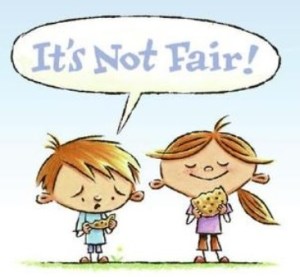
Children develop a sense of fairness from an early age. Hitting someone younger and weaker is unfair. Collective punishments are unfair. Paying pocket money below the going rate, determined by a survey of one’s peers, is unfair.

On Tuesday our Treasurer presented the annual budget to Parliament and announced it to be ‘a fair budget’. ‘Fair’ is now the top buzz-word in Australian politics. The trouble is that the word means different things to different people.

On the left of politics, it means taking more from the rich and distributing it to the non-rich. The exact positioning of the dividing line between the rich and the non-rich is itself a matter for debate of course. Or rather, it is left to each elector to decide which side of the line he or she sits. For most of us ‘rich’ is defined as ‘better off than me’, so policies that involve taking from the rich are generally popular.

But on the right of politics fairness involves allowing people to earn and retain as much as possible of the value of what they produce. According to the Economics textbooks, that value is represented by the wage or profit that the free market assigns. So whether one is a banker, a nurse, a soldier or a casino owner, what you receive is what you’re worth. Obviously it’s unfair to take more from the most productive members of society.

The Economics textbooks support the left-wing view too though. They point out that an extra dollar in a poor man’s pocket does him more good than it would do for a rich man, so the total wellbeing of society will always be increased by redistributing from rich to poor until perfect equality is achieved.

I would rather take ‘fair’ out of the conversation and substitute ‘pragmatic’. The rich always have to pay more (both absolutely and relatively) because, to borrow bank-robber Willie Sutton’s famous quotation, “That’s where the money is.” But the rich are also the most able to find ways to avoid and minimise taxation; or, if paying tax in Country A becomes too onerous, move to Country B.

So it’s a balancing act. Pragmatism is all. To paraphrase a line by Clint Eastwood, “Fair’s got nothin’ to do with it.”

Disruptive Technology

Standard

Disruptive technologies are scary.  Uber is one of the scariest, in Australia anyway, because many people have invested 6-figure sums in taxi licences on the assumption that their value can only go up.  Airbnb is another one.  People have invested millions in hotels, meeting all the health, safety, traffic management and other government requirements, only to find that anyone with a spare room is a potential competitor.

My view is simple. In the long run the most efficient way of doing something will always displace the other ways.  Vested interests will howl in pain and rage, and for a while they will hold back the incoming tide.  But eventually, as King Canute found out, they will have to yield.

I remember attending a conference 20+ years ago at which the late James Strong, then CEO of Qantas, argued for a lifting of the ban on Qantas carrying passengers between Australian airports.  The purpose of the ban was to protect the Ansett/TAA duopoly of domestic routes, and it meant that Qantas was flying half-empty ’planes around.  It couldn’t go on forever and it didn’t.  Economic and commercial rationality prevailed – as it must in the taxi and accommodation sectors.

Instead of emulating King Canute, governments should:

  • Create sensible regulatory frameworks for the new technologies, to ensure public safety and payment of taxes.
  • Review the rules and taxes that make it hard for established businesses to compete on equal terms with the disruptors.
  • Ease the pain for the people whose lives and businesses are unexpectedly disrupted, eg by buying back taxi licences.


Fairness

Standard

Australian politicians, commentators and interest groups have embarked on a public discussion about tax reform. The main focus is the GST (goods and services tax = value added tax).  Should the rate, which has remained at 10% since inception in 2000, be increased to 15%?  Should the base be broadened to include some or all of the 53% of goods and services that are GST-free?

There is one thing that everyone agrees on: whatever changes are made to the tax system, they must be fair. I haven’t heard anyone say, “What this country needs is unfair taxation!”  But I suspect that the concept of fairness is not universal.

The Australian Council of Social Service (ACOSS) describes itself as “the national voice for the needs of people affected by poverty and inequality.” In their eyes ‘fairness’ means not increasing the share of the tax burden born by the poor.  In a radio interview this morning an ACOSS representative expressed the view that no household with an annual income below $100,000* should have to pay more tax than they do now.

But some other people see fairness differently. They think that people who work hard, learn productive skills, practise thrift and invest prudently should, in fairness, be allowed to reap and keep the harvest that results from this pattern of behaviour.

What do I think?

  • We cannot continue running a fiscal deficit forever.
  • The cost of health care will continue rising faster than GDP as more ways are found to cure illnesses and keep people alive.
  • The cost of supporting and caring for old people and disabled people will also rise faster than GDP.
  • Richer people are better able than poor people to minimise the amount of tax they pay – ultimately by emigrating.
  • Multinational corporations will always find ways to avoid paying normal rates of tax in the countries where they make their money.

Putting all these thoughts together, I don’t see how anyone but the very poorest can avoid paying more, either through taxes or by paying the full price for things that they have been accustomed to getting free or at subsidised prices.

Footnote

* From official statistics for 2013-14 I infer that about two-thirds of Australian households fall below this threshold.